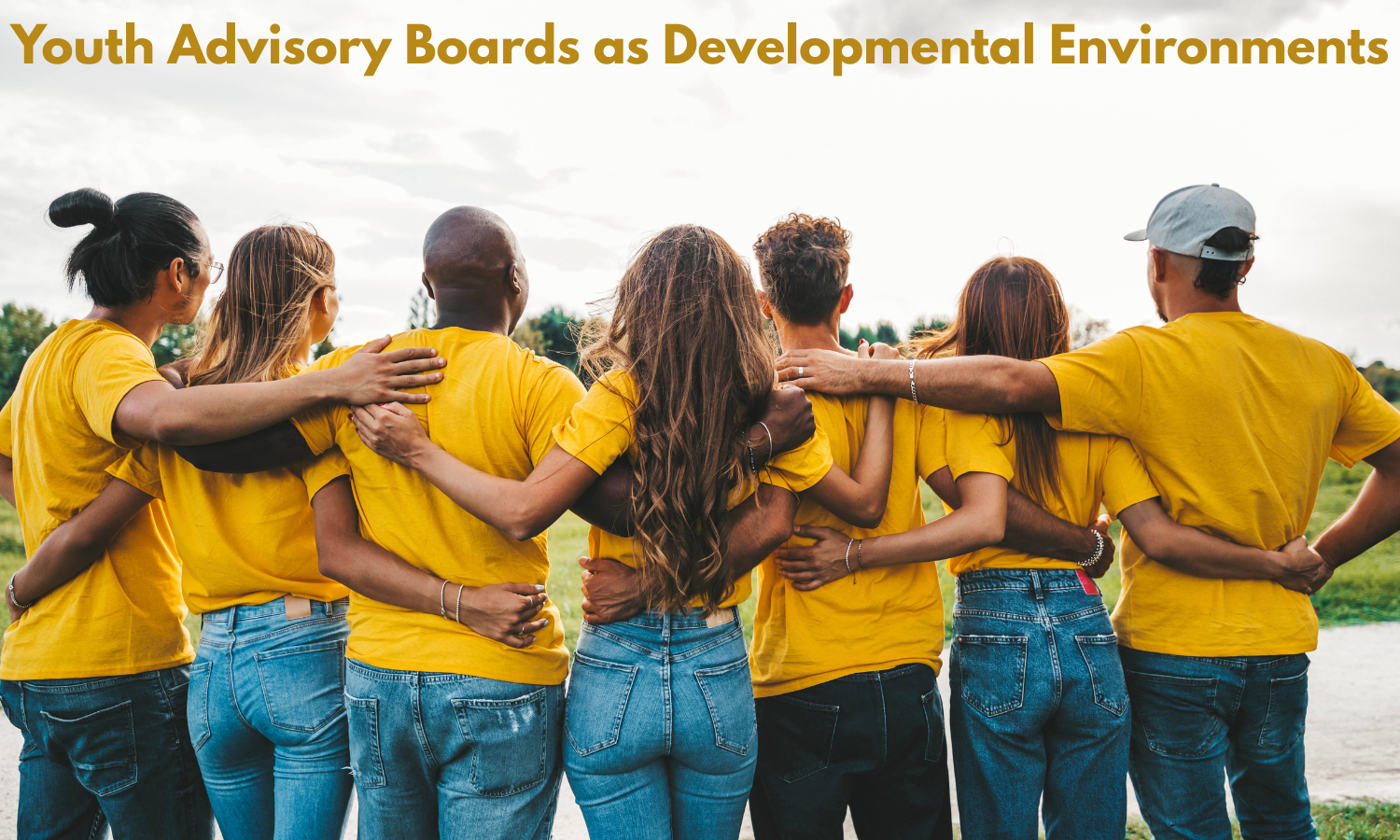
Youth Advisory Boards: Why structure matters more than good intentions
By Dr. Cristin Rollins, Phd
I watched something remarkable happen in a Youth Advisory Board (YAB) meeting recently. A group of teenagers was planning a program for their community organization. One young woman—quiet, usually in the background—offered an idea that contradicted what the adults had proposed.
The facilitator leaned in. "Tell us more about that. What are you seeing that we're missing?"
The young woman explained. The group listened. They shifted course.
That moment didn't happen by accident. It happened because the environment was designed for it. The session opened with connection-building. The group had shared norms they'd co-created. Reflection was built into the rhythm of every meeting. And the adults in the room understood their role as facilitators of development, holding space for young people to practice real skills in real conditions.
That's what makes this kind of moment possible. And that's what many Youth Advisory Boards are missing.
The Two Traps
Most Youth Advisory Boards (YABs) fall into one of two predictable patterns. In the first, youth are present but nothing developmental is happening. They sit on a panel, attend a meeting, give input that may or may not go anywhere. Adults check the "youth voice" box. Youth experience it as performative. They know when they are decoration.
In the second, the structure looks more robust—regular meetings, clear agendas, defined roles—but the underlying power dynamic is unchanged. Youth advise. Adults decide. The YAB serves the organization's needs for input, and the young person's need for growth is incidental. So information is not only extractive, but, potentially, because the cabinet lacks developmental infrastructure, the same patterns of access and visibility get reproduced inside it: the most confident youth dominate, the quietest youth recede, and the organization calls it voice.
Both patterns share a common root: the YAB was designed as a structure, and no one thought about what kind of environment it creates.
Environments Shape Character
At the Character Impact Lab, we're grounded in a core idea: environments shape character. Young people develop character when they regularly practice essential interpersonal and self-management skills inside supportive, intentionally designed spaces we call Character Forward Environments.
Character Forward Environments share a set of defining conditions: psychological safety, shared norms, meaningful participation, appropriate challenge, reflection, and repair and accountability. When these conditions are present, young people have repeated opportunities to practice skills like collaborative problem-solving, constructive communication, perspective-taking, accountability, and follow-through. Through that repeated practice in real interactions, young people develop the character strengths—empathy, responsibility, perseverance, integrity, leadership, service—that support their wellbeing and their ability to contribute positively to their communities.
A Youth Advisory Board, when it's designed with these conditions in mind, becomes one of the most powerful Character Forward Environments an organization can create. Think about what young people practice in a well-designed board: decision-making when they weigh competing perspectives, accountability when others are depending on them, constructive communication when they disagree, perspective-taking when someone sees something they missed, and growth orientation when an initiative gets blocked or a meeting goes sideways.
The question is whether the board is designed so these capacities can actually develop—or whether it's left to chance.
What Makes the Difference Is Structure
The difference between a Youth Advisory Board that develops character and one that decorates a program comes down to how the environment is built. It's structural.
Psychological safety and shared norms. Every session opens with relational grounding—practices that build trust, surface identity, and create the conditions needed for honest voice. The group has norms they co-created and return to regularly. Young people know what to expect and what's expected of them, which frees them to take the kinds of risks that build character.
Meaningful participation. Young people contribute in ways that matter to the functioning of the group and the organization. Their roles are real. Their input shapes actual decisions. They can see the line between what they said and what changed. When young people experience their participation as meaningful, belonging grows through contribution.
Reflection and repair. Reflection is woven throughout every session—brief pauses, processing questions, moments to make meaning. "What did you notice about how the group just worked through that?" "What helped you stay with it when that got hard?" And when things go wrong—when conflict happens, when someone gets frustrated, when a commitment falls through—repair is modeled and expected. Mistakes become practice opportunities.
Appropriate challenge. The work itself is real and stretching. Young people are reviewing frameworks, designing programs, analyzing data, planning events, making decisions with consequences. The work asks something of them, and that's the point. Character develops through challenge, and a board that keeps things comfortable is a board where very little is being practiced.
It Has to Be Real
Here's where I think most YABs miss the mark: the work has to actually matter.
If young people know their input goes nowhere, the YAB teaches them that their voice doesn't really count. I've seen it happen. Youth who start energized, offering real ideas, real criticism. And then nothing changes. The organization thanks them and the young people watch from the sidelines as adults do exactly what they were going to do anyway.
That's extraction. And young people feel the difference immediately.
A YAB with developmental integrity means young people help shape decisions, they can see how their input influenced what happened next, adults take hard questions seriously, and youth participation influences outcomes in visible ways. This requires a genuine willingness from organizations to share power. And that's harder than it sounds, because it means being ready for youth voice that's critical, that challenges assumptions, that makes adults uncomfortable.
Why This Matters Right Now
Young people today face crises they didn't create but have to navigate. They need real practice in influence, decision-making, and belonging. They need spaces where their perspectives shape outcomes and where the conditions are right for them to develop the capacities that will carry them forward.
A well-designed Youth Advisory Board is exactly that kind of space. That quiet young YAB member who offered a different perspective? A week later, she contributed an idea in her English class. A month later, she ran for student government at her school. She's not magically more confident. She's starting to see herself as someone whose thinking has value—because an environment was built where she could practice using it.
That's development. And it ripples outward from there.
What does youth voice look like in your organization? Is it structural—built into the environment, with shared norms, meaningful participation, reflection, and real influence? Or is it episodic—dependent on the moment, the adult, or the mood?
The environment you build shapes what young people get to practice. And what they practice, develops.
What's Next
The Character Impact Lab team is developing a new resource to help organizations build YABs that are designed as Character Forward Environments and true vehicles for youth voice and governance. Stay tuned!
In the meantime, take a look at Character, Clearly, a short guide that helps teams name character where it already lives in their work and build shared language around it.
Partner with our experts to design a Youth Advisory Board for your organization. Reach out: hello@statementhouse.net 💌